
Scam breakdown
IRS or Tax Scam Calls: How to Recognize One
Short answer
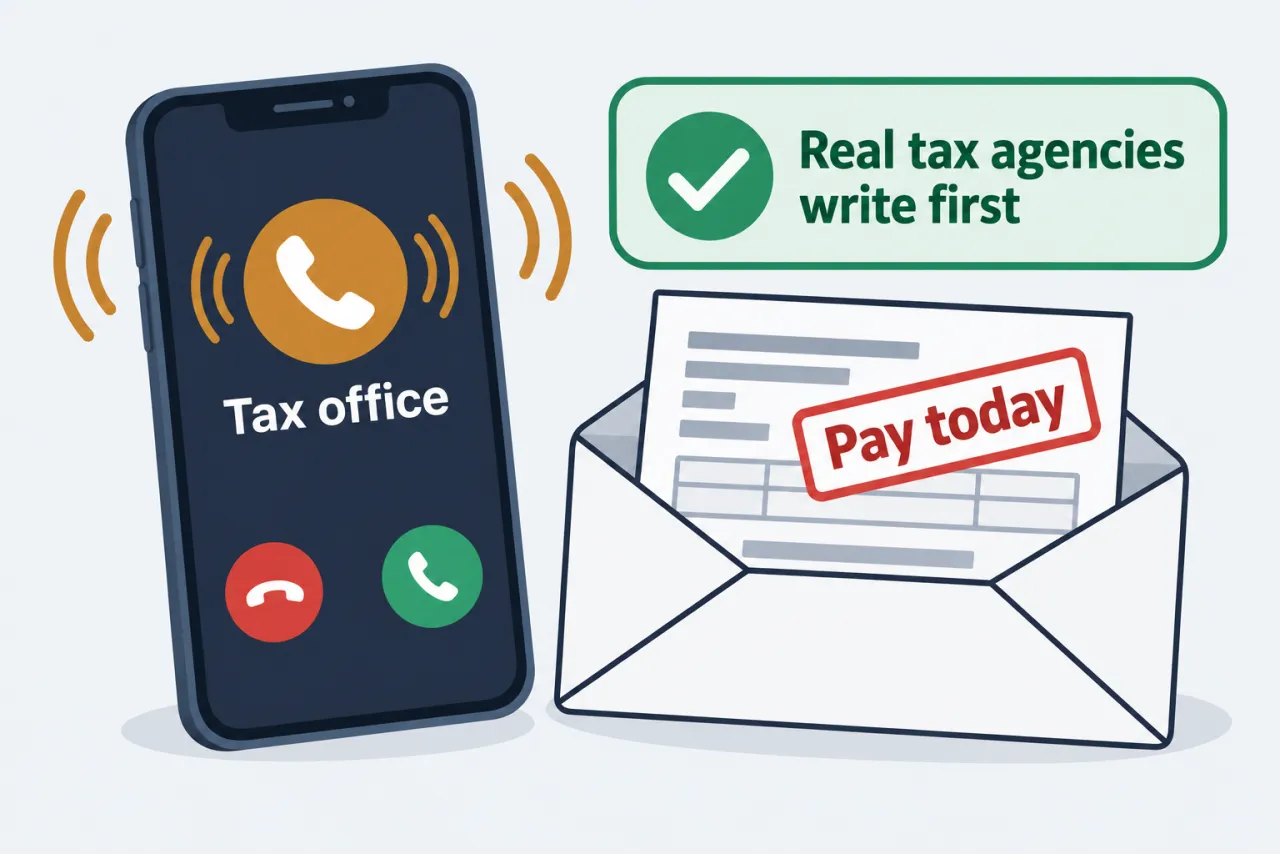
That threat-and-deadline call is the classic tax scam. Below: how the script sounds, how the real agency behaves, and the calm steps to check and report it.
Show me the red flagsWe are an independent guide. We never ask for your Social Security number, tax details, or payment.
- Defense, not lookup
- We help you recognize and report a scam call, not identify or trace who called.
- Official sources
- The tells here come from the FTC and public guidance from the tax agency.
- Independent
- CallerCheck is not the IRS, the FTC, or any government body.
How a tax scam call sounds versus the real agency
The script leans on fear and speed; a genuine tax matter never works this way.
-
“You owe back taxes and will be arrested or deported today unless you pay.”
Why it’s fake: The FTC says real law enforcement and federal agencies won't call and threaten you; the IRS lists arrest threats as an impersonator tactic.
-
“You cannot question or appeal the amount; you must pay right now.”
Why it’s fake: Removing your right to ask questions or appeal is a pressure tactic, not how a real tax bill is handled.
-
“Pay only by gift card, wire transfer, crypto, or a payment app.”
Why it’s fake: The FTC notes anyone who insists you can pay only in these hard-to-reverse ways is a scammer.
-
“Confirm your Social Security number to verify your identity.”
Why it’s fake: The FTC says no government agency cold-calls to ask for sensitive details like your Social Security number.
What the real organization does
- The tax agency says it generally initiates contact by mail, not a surprise threatening call.
- You keep the right to question and appeal what you actually owe.
- Real payments go through the agency's own official payment pages, never gift cards or an account a caller names.
- To check a tax matter, type irs.gov into your browser yourself and use the contact listed there, or sign in to your IRS online account to see any real balance.
The real tax agency versus the scam caller
Line the two up side by side and the fake collapses fast.
| Criterion | A real tax agency | The scam caller |
|---|---|---|
| Time to respond | A letter gives you time to read it and reply. | Says it must be settled today, on this call. |
| If you hang up | A real matter is still there when you check it yourself. | Warns that hanging up means a warrant for your arrest. |
| Threats | Does not threaten arrest or deportation by phone. | Threatens jail, deportation, or a warrant to scare you. |
| Payment | Payment goes through the agency's own official payment pages, which you open yourself. | Demands gift cards or crypto, or a wire or app payment to an account the caller names. |
| Caller ID | The IRS does not rely on your screen to prove who it is. | Points to "IRS" on your caller ID as proof, though caller ID can be spoofed. |
If the call carries threats, a no-appeal line, and an odd payment demand, treat it as a scam and hang up.
What this guide covers
This guide helps you
- Help you recognize the tax-scam script
- Show you how to report the call to the FTC
- Point you to official ways to verify a real tax matter
- Tell you to contact police if a threat feels real
This guide never
- Identify, trace, or unmask who called you
- Promise we can stop every scam call
- Ask for your SSN, tax records, or payment
- Tell you to pay a caller to clear a warrant
Reverse lookup here means deciding whether a call is a known scam and how to report it, never finding or tracking the person behind a number.
Got a tax scam call? Do this
The same steps work whether you hung up right away or already engaged.
If a caller made a real threat to your safety, contact local police first, then come back to reporting.
-
Hang up, do not pay
End the call and never buy gift cards or wire money to clear a supposed tax debt.
-
Verify on your own terms
Verify any tax matter yourself, never through the number the caller gives you.
-
Report the call
Report the number, date, and time at reportfraud.ftc.gov; TIGTA also takes IRS impersonation reports.
-
If you paid or shared your SSN
Call your bank via the number on your card; see 'I gave a scam caller my info'.
Report the call to the FTC →
Questions people ask
Does the IRS ever call about unpaid taxes?
The IRS says it generally first contacts people by mail, not with a surprise threatening phone call. A cold call that demands instant payment, forbids you to appeal, and threatens arrest is the classic scam script. If you are unsure a tax matter is real, verify it yourself rather than through the caller's number.
The caller ID showed IRS and a Washington DC area code. Doesn't that prove it's real?
No. Caller ID can be spoofed, so scammers can make any name or area code appear on your screen. The FTC warns that a name or number matching a real agency is not verification. Judge the call by what it asks for, not by what the screen says.
They demanded payment in gift cards. Is that ever legitimate?
A caller who insists you pay a tax bill only by gift card, crypto, wire, or a payment app is a scammer, the FTC says. No tax agency takes gift cards. Real payments go through the agency's own official payment pages, never to an account a caller reads to you over the phone. Treat that demand alone as proof the call is fake, and hang up.
How do I report an IRS or tax scam call?
Report the number, date, and time of the call at reportfraud.ftc.gov. You can also report tax impersonation to the Treasury Inspector General for Tax Administration through the channel listed on the tax agency's official site. Reporting helps investigators even if you were not harmed.
I already paid or gave them my Social Security number. What now?
Act quickly. Report the call to the FTC, watch your bank and card accounts for activity you did not authorize, and contact your bank if you sent money. Our guide for after you shared information with a scam caller walks through the full set of steps.
Official sources
Rules and phone settings change. Check the current page before you act.
- reportfraud.ftc.gov — reportfraud.ftc.gov