
Scam breakdown
"Your Bank" Called About Fraud? How to Spot the Fake
Short answer
Scammers spoof caller ID to look like your bank, say there's fraud on your account, and push you to act fast. The two moves that give them away: they tell you to move your money to a "safe account," or they ask you to read back a verification code. A real bank does neither. When in doubt, hang up and call the number on the back of your card.
See how a real bank behavesCallerCheck doesn't ask for your account details, card numbers, or codes. This is guidance only.
- Call the number on your card
- Hang up and dial the number on the back of your card, never the caller's number.
- Codes stay with you
- A real bank never asks you to read a one-time verification code out loud to an inbound caller.
- Independent guide
- CallerCheck is independent and not a bank; verify anything you're told inside your own bank app.
How a real bank behaves vs the scam "fraud" call
Same claim, opposite behavior; the difference is in what they ask you to do next.
| Criterion | A real bank or card issuer | The scam "fraud department" call |
|---|---|---|
| What they do about your money | Freezes or flags the suspect charge for you; your money stays where it is. | Tells you to "move your money to a safe account" to protect it right now. |
| Verification codes | Sends you a code to type into the app or site yourself, and never asks you to read it back. | Asks you to read the code aloud so "we can confirm it's you." |
| Pace and pressure | Gives you time and is fine with you ending the call. | Insists you stay on the line and act immediately or lose your money. |
| Where the conversation goes | Handles it within your account; you can verify every step inside the app. | Has you buy gift cards or use a crypto ATM to "protect" the money. |
| Who calls whom | May text, notify you in the app, or call; either way you can hang up and check with the bank yourself. | Cold-calls you, and the number on your screen looks like the bank's, which proves nothing. |
The FTC's rule is blunt: anyone who says you must move your money to protect it is a scammer. Hang up and call the number on the back of your card.
Check your own bank first, not the caller
Before you believe a word, look at what your bank actually shows you.
| Sign | What to check: | Where to look |
|---|---|---|
| Your bank's own app | If your bank really flagged something, you can usually see it in the app or online banking too; if you can't, contact the bank yourself instead of acting on the call. | Your bank's official app, opened from your home screen, not a link the caller sends. |
| Your recent-calls log | A caller ID that matches your bank's name or number is not proof; spoofing copies both. | The recent-calls or call-history screen on your phone. |
| Your statement and transactions | Check for the charge they claim is fraud; if you can't see it in your own transactions, don't act on their word. | Your transaction list in the app, online banking, or your paper statement. |
| The number on your card | Compare the number the caller gives you with the one printed on your card; only the printed one is trustworthy. | The back of your debit or credit card, or the customer-service line on your statement. |
Note: These are your own accounts and your own phone; you're only verifying information about yourself, never looking up or contacting anyone else.
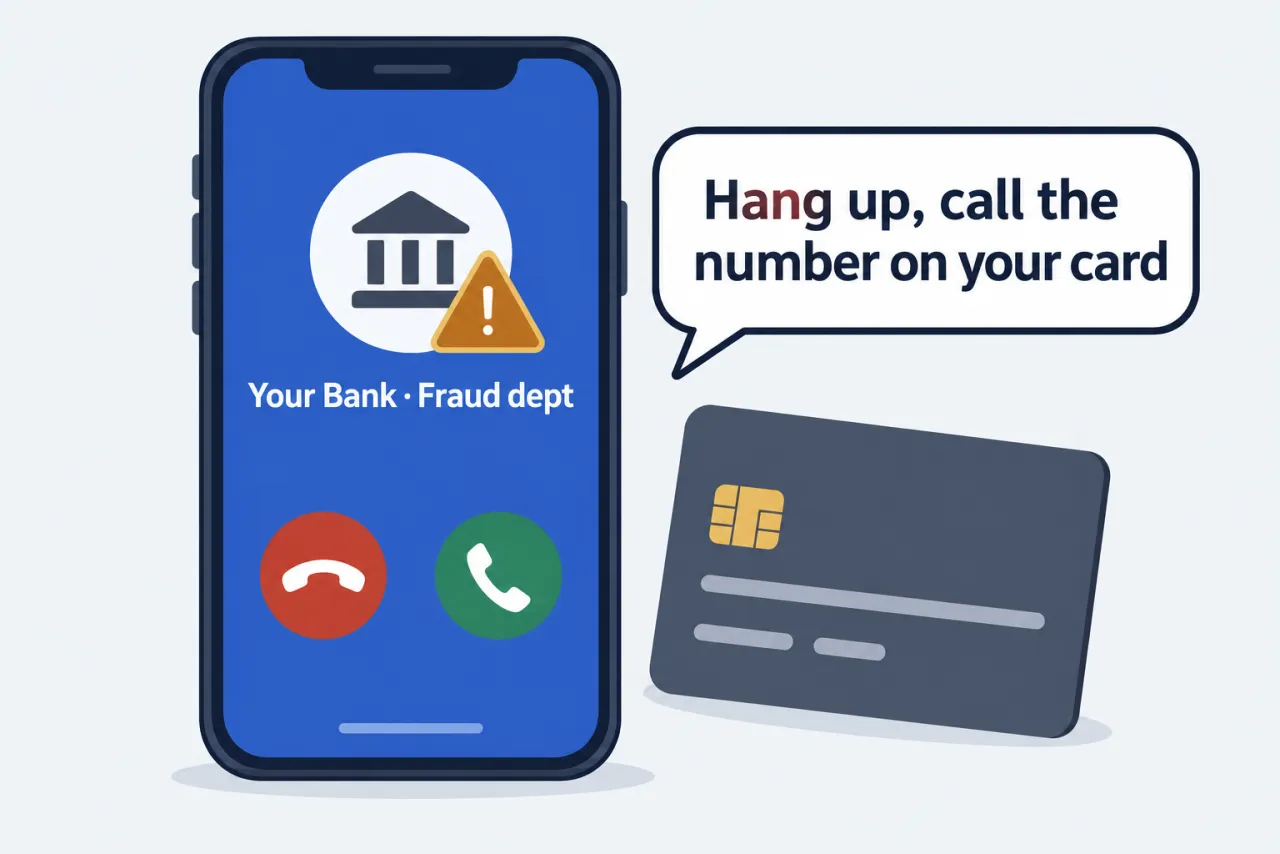
How the scam call pressures you — and what it means
These are the caller's own lines; the secrecy and hurry are what give the scam away.
-
“Whatever you do, don't hang up; if you leave the line the transfer won't go through.”
Why it’s fake: A real bank is fine with you hanging up and calling back; keeping you on the line is how a scammer stops you from checking.
-
“Don't tell the teller what this is for, just say it's money for family.”
Why it’s fake: Being asked to lie or keep it secret is a tell; a genuine bank has no reason to hide a transfer from its own staff.
-
“I'm transferring you to our fraud department, or to an FTC or FBI agent, to secure your account.”
Why it’s fake: The FTC warns the 'transfer' is to another scammer; real banks don't hand you to federal agents to move money.
-
“Stay on the phone with me while you go to your bank or a cash machine.”
Why it’s fake: Being walked to a branch or a crypto or cash machine while kept on the call is a scripted scam move, not a bank procedure.
What the real organization does
- Hang up and call the number on the back of your card or on your statement, never the number the caller gave you.
- Verify any fraud claim inside your own bank app before moving money or sharing anything.
- Never read a one-time code aloud; you type codes into the app or site yourself.
- If you already moved money or shared a code, tell your real bank right away and report it at reportfraud.ftc.gov.
Questions people ask
The caller knew my name and my bank. Is that enough to trust them?
No. The FTC warns that criminals spoof caller ID, so a matching bank name or number proves nothing, and personal details can be bought or guessed. Verify through your own bank app or card instead.
The caller says there's fraud and I need to move my money to a safe account. Is that real?
That is the defining move of a bank-impersonation scam. The FTC says your money is fine where it is, and anyone who insists you move it to protect it is a scammer. Don't transfer anything. Verify through your own bank app or card instead.
Why won't a real bank ask me to read back a verification code?
Banks use those one-time codes to prove you're really you. If you read the code to a caller, they can use it to prove they're you. A real fraud department never asks you to share it out loud.
How do I check whether the fraud alert is genuine?
Open your bank's own app yourself and look for the alert there, and check whether the charge they describe actually shows in your transactions. A real alert is something you can verify inside the app, not just a pressuring phone call.
I already moved money or shared a code. What now?
Tell your real bank now using the number on your card, then follow the step-by-step recovery guide for what you shared.