
Scam breakdown
Car Warranty and Other Common Robocall Scripts
Short answer
Most spam calls reuse a handful of recorded scripts. Once you know how the auto-warranty, lower-your-rate, utility and prize calls open, you can recognize them in the first few seconds. None of them is a real offer. Do not press a key, even to be removed (our robocall guide explains why): hang up, then block and report.
See the common scriptsCallerCheck does not look up who owns a number. This is about recognizing a scam script, not identifying a person.
- Recognize, do not engage
- Each script comes with the one line that gives it away, so you can hang up early.
- Sourced to the FTC and FCC
- Each script is based on FCC and FTC consumer guidance and attributed where cited.
- Independent guide
- CallerCheck is not a carrier, phone maker or lookup service and sells no number database.
The pressure lines that give each script away
Four lines lifted from real robocall scripts, and why each one is a tell.
-
“This is the final notice about your vehicle's manufacturer warranty. Press 1 now or we close your file.”
Why it’s fake: The FCC says these callers are not your dealer or maker; the deadline is invented to make you press a key.
-
“You will receive a rebate check along with a 30% discount on your electric and gas bill. Press 1 to get your rebate.”
Why it’s fake: The FTC lists this utility-impersonator pitch among its robocall scam examples; a real utility bills you, it does not robocall rebates.
-
“To activate coverage today we just need your VIN and a card number for the down payment.”
Why it’s fake: The FCC and FTC say not to give these callers any personal or financial information; the product is a service contract that often costs hundreds or thousands of dollars.
-
“You have won a prize; just cover the small fee or taxes to release it.”
Why it’s fake: The FTC puts it simply: if you have to pay to get a prize, it is not a prize.
What the real organization does
- A real company you already do business with does not cold-call with a recorded countdown to press a key.
- If an offer might be genuine, hang up and call the number on your own paperwork, card or the firm's official site.
- A name or number matching a real business on your screen is not verification, because caller ID can be spoofed.
- To check your real vehicle coverage, read your purchase paperwork or call the dealer on a number you already have.
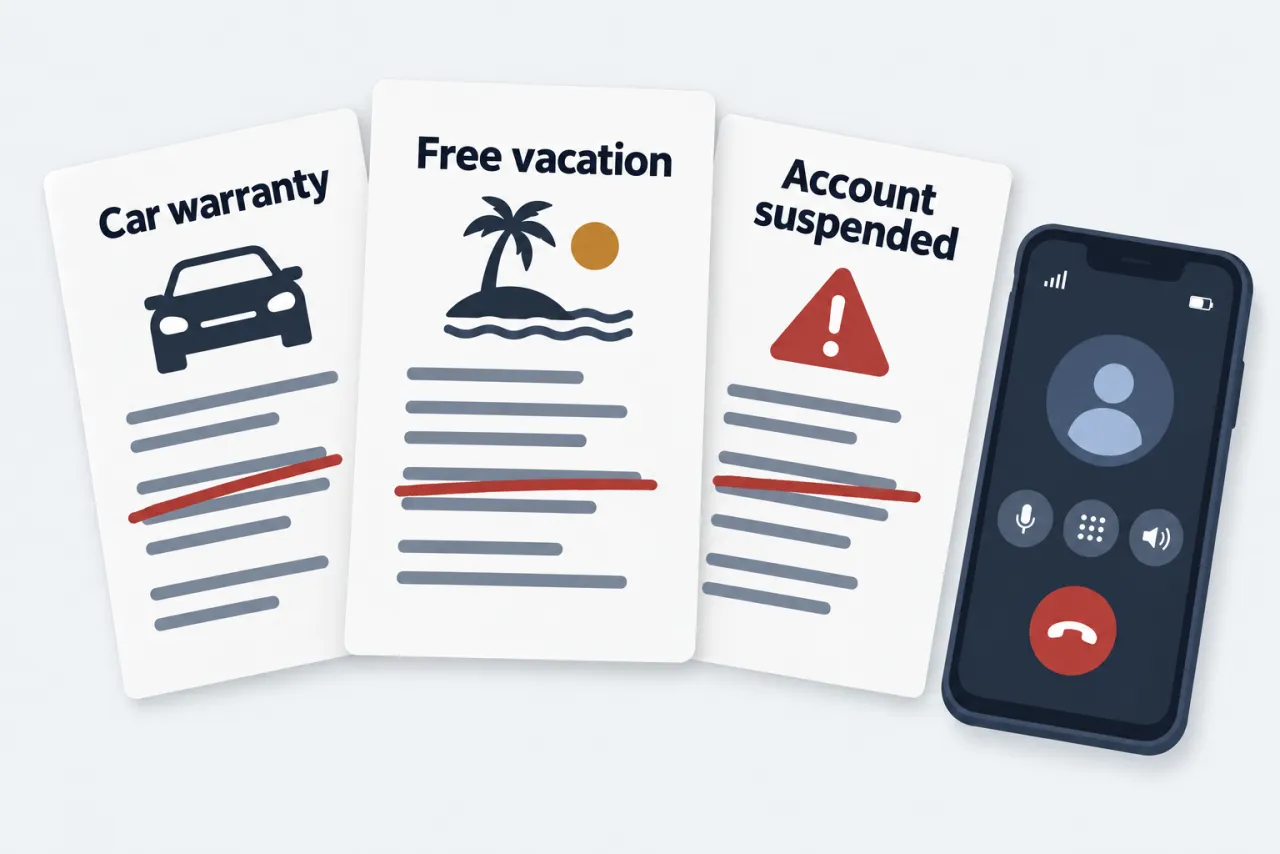
The recurring robocall scripts, one at a time
For each script: the hook it opens with, the tell that gives it away, and the move.
-
Auto-warranty call
Hook: final notice on your car's warranty. Tell: a service contract, not your maker. Move: hang up, report.
-
Lower your rate
Hook: you qualify for a 0–5% rate. Tell: press 1 to proceed. Move: hang up; call the number on your card.
-
Utility company call
Hook: a rebate, a bill discount or a shutoff warning. Tell: press 1 or pay now. Move: hang up; call the number on your bill.
-
Prize or sweepstakes
Hook: you won a prize. Tell: a fee or taxes to release it. Move: pay nothing, hang up, report.
Note: Scripts drawn from the FCC auto-warranty guide and the FTC Robocall Scam Examples library; wording varies by campaign.
Questions people ask
Is the car warranty robocall ever a real offer from my dealer or manufacturer?
No. The FCC says these callers are not your dealer or the vehicle's manufacturer. A manufacturer warranty comes with the vehicle and is already in your paperwork; you never buy it over the phone. What these calls sell is a separate vehicle service contract, which the FCC says often costs hundreds or thousands of dollars, dressed up with the word warranty because it sounds official. Talk of a final notice or a file about to close is pressure, not fact. To check your actual coverage, hang up and call your dealer on the number in your own paperwork.
Is a utility company robocall offering a rebate or warning of a shutoff real?
Treat it as a scam. The FTC lists a utility-impersonator robocall, promising a rebate check and a bill discount if you press 1, among its robocall scam examples. Do not press a key or pay on that call. Hang up and call the number printed on your own bill to ask whether anything is wrong with your account. Shutoff notices normally come through your utility's own billing channels, though practices vary by provider.
Is a 'lower your interest rate' robocall ever a legitimate offer?
No. The FTC lists 'lower your credit-card interest rate' among its common robocall examples. A recorded call promising to slash your rate, usually for an upfront fee or after you hand over your card number, is a sales pitch at best and a scam at worst. Your own card issuer does not cold-call you this way. If you want a lower rate, hang up and call the number on the back of your card.
I already pressed 1 or agreed to a warranty plan on the call. What now?
Stop engaging: do not take follow-up calls from that seller or give any more details. If you paid with a card, contact your card issuer using the number on the card and tell them what happened. Report the call at ReportFraud.ftc.gov. Whether a charge can be reversed depends on your issuer and how you paid, so there is no guaranteed outcome. For next steps on protecting details you shared, see our guide on what to do after giving a scam caller your information.