
Explainer
The Do Not Call Registry: What It Stops, What It Can't, and Why It's Still Worth It
Short answer
Registering at DoNotCall.gov is free, never expires, and tells law-abiding companies not to make sales calls to your number. Scam callers are already breaking the law, so a list doesn't stop them. Knowing that line tells you what to expect and what a call that still gets through probably is.
See who has to honor itWe never ask for your phone number; register only on the official DoNotCall.gov site or by phone.
- FTC-sourced facts
- Registration rules and exemptions follow the FTC's own Do Not Call FAQ.
- Honest limits
- We say plainly what the registry can't do, including stopping scam calls.
- Independent guide
- CallerCheck isn't affiliated with the FTC, any carrier, or any phone maker.
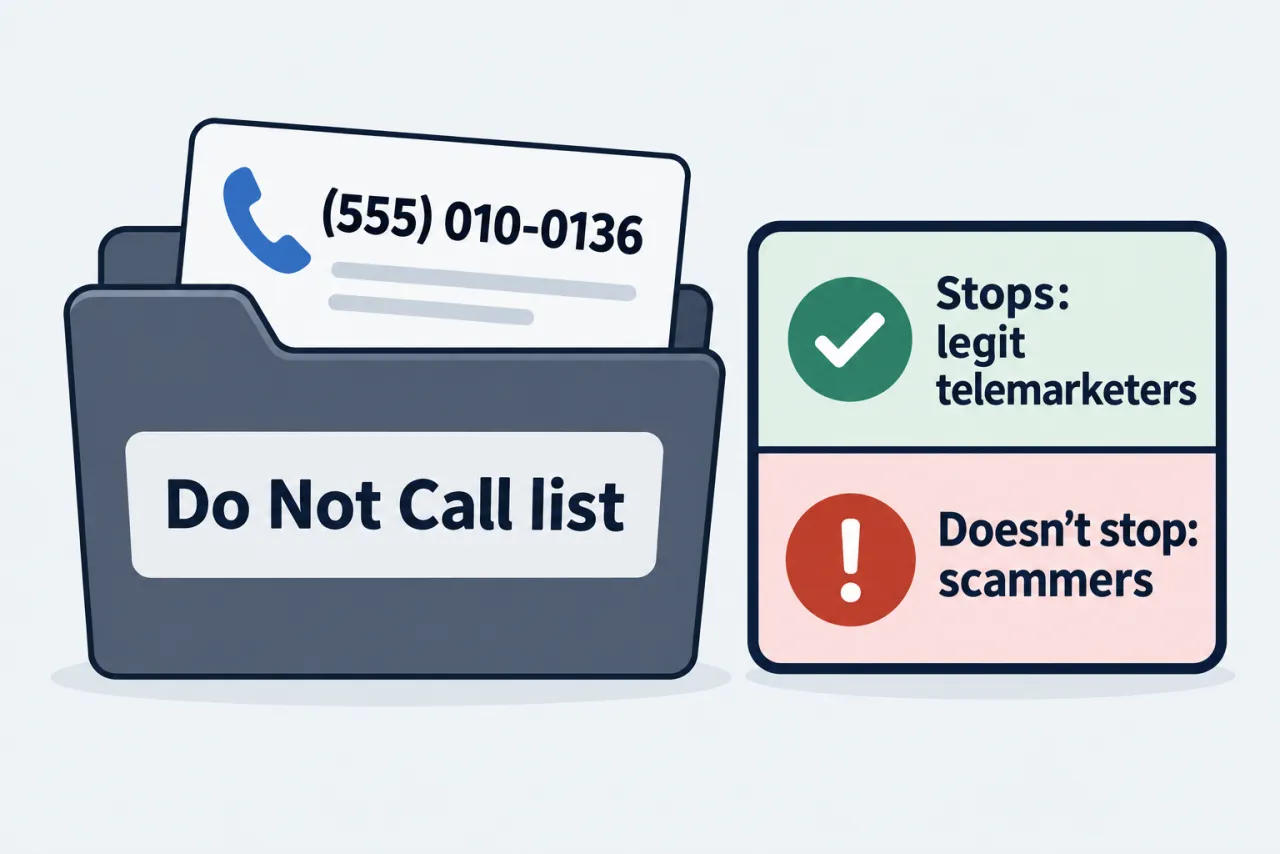
Who Honors the Registry, and Who Ignores It
The registry is a rule for companies that follow the law; scammers were never playing by it.
| Criterion | Law-abiding telemarketer | Scam caller |
|---|---|---|
| Checks the registry | Must scrub its call lists against the registry before making sales calls. | Never checks it; its calls are illegal whether or not you register. |
| When you've registered | Sales calls should stop within up to 31 days, per the FTC. | Nothing changes, because the calls were already illegal. |
| Caller ID | Must send a real callback number, but caller ID alone never proves a call is legitimate. | Often faked to look local or official, so the number proves nothing. |
| Risk of penalties | The FTC says violations can cost up to about $50,000 per call. | Already breaking the law, so a registry listing adds no new deterrent. |
| What they want | To sell a product, and must stop if you ask not to be called. | Money, gift cards, codes, or personal details under false pretenses. |
Register to cut legitimate sales calls. After 31 days, a sales call from a company you've never dealt with is a likely scam, not proof the registry failed.
"I Registered but Still Get Calls": What to Expect by Call Type
The band shows how likely registering is to reduce each kind of call.
-
Sales calls from real companies you've never dealt with
HighWhat helps: These companies must honor the registry once your number has been listed long enough.
What gets in the way: It can take up to 31 days before they stop.
-
Sales calls from a company you recently bought from
MediumWhat helps: Asking them directly not to call you again should end it.
What gets in the way: A past purchase or written permission you gave lets them call despite the registry.
-
Political, charity, survey, or debt-collection calls
LowWhat helps: Charity telemarketers must honor a direct request to stop calling.
What gets in the way: The FTC lists these call types as outside the registry's scope.
-
Scam calls and illegal robocalls
LowWhat helps: Blocking, carrier spam filters, and not answering unknown numbers cut them.
What gets in the way: Scammers ignore the registry because their calls are already illegal.
Note: These are qualitative expectations based on the FTC's description of the registry, not measured rates; results vary by caller and carrier.
How to Register, Check, and Use It
Four facts cover everything you need to do with the registry.
-
Register free
Sign up at DoNotCall.gov or call 1-888-382-1222 from the phone you want listed.
-
Never expires
Your number stays listed unless it's disconnected, reassigned, or you ask to remove it.
-
Verify anytime
Check your registration at DoNotCall.gov or by calling the same number from that phone.
-
Ask them directly
Tell a company you've dealt with to stop calling; the registry doesn't cover past customers.
Note: When you register online, confirm through the email link within 72 hours. No legitimate service charges a fee to register you.
Questions people ask
I'm on the Do Not Call Registry. Why am I still getting calls?
Most calls that get through are either exempt from the registry, such as political, charity, survey, debt-collection, or informational calls, or they're scams. Scammers ignore the registry because their calls are already illegal. A sales call from a company you've never dealt with, arriving more than 31 days after you registered, is a strong sign it's not a legitimate business.
Does my registration expire?
No. According to the FTC, a number stays on the registry permanently unless it's disconnected and reassigned, or you ask to have it removed. You don't need to re-register.
Does it cost anything to register?
No. Registration at DoNotCall.gov or by phone at 1-888-382-1222 is free. Anyone who calls offering to put you on the list for a fee is running a scam.
Can I register my cell phone?
Yes. You can register cell phones and landlines. If you register by phone, call from the number you want to add.
What should I do when a registered number still gets a sales call?
Don't press any keys or call back. Report it; our guide to reporting a spam call shows which FTC form fits.