
Step-by-step guide
You Gave a Scam Caller Your Information — Now What
Short answer
People of every age get caught by practiced scam scripts. What you shared decides who you call first, then you report it to the FTC.
Show me what to do firstWe are an independent guide. We never ask for your card, bank, or Social Security details.
- Official steps only
- Every step follows the FTC guidance on what to do if you were scammed.
- Money-mover first
- You contact your bank, card issuer, or payment company directly, never through us.
- No blame, no upsell
- We sell no recovery service and never promise to get your money back.
Why today is better than next week, without panic
Nothing here is a countdown; acting sooner simply keeps more options open.
- Banks, card issuers, and payment apps can only try to stop or reverse a payment they know about.
- A card issuer can cancel a card number before a scammer uses it again.
- A fraud alert makes it harder for someone to open new credit in your name.
If days have already passed, the same steps still apply. There is a real path at every stage, and being tricked says more about the scammer's script than about you.
Start with the first callYour next moves, ordered by what you shared
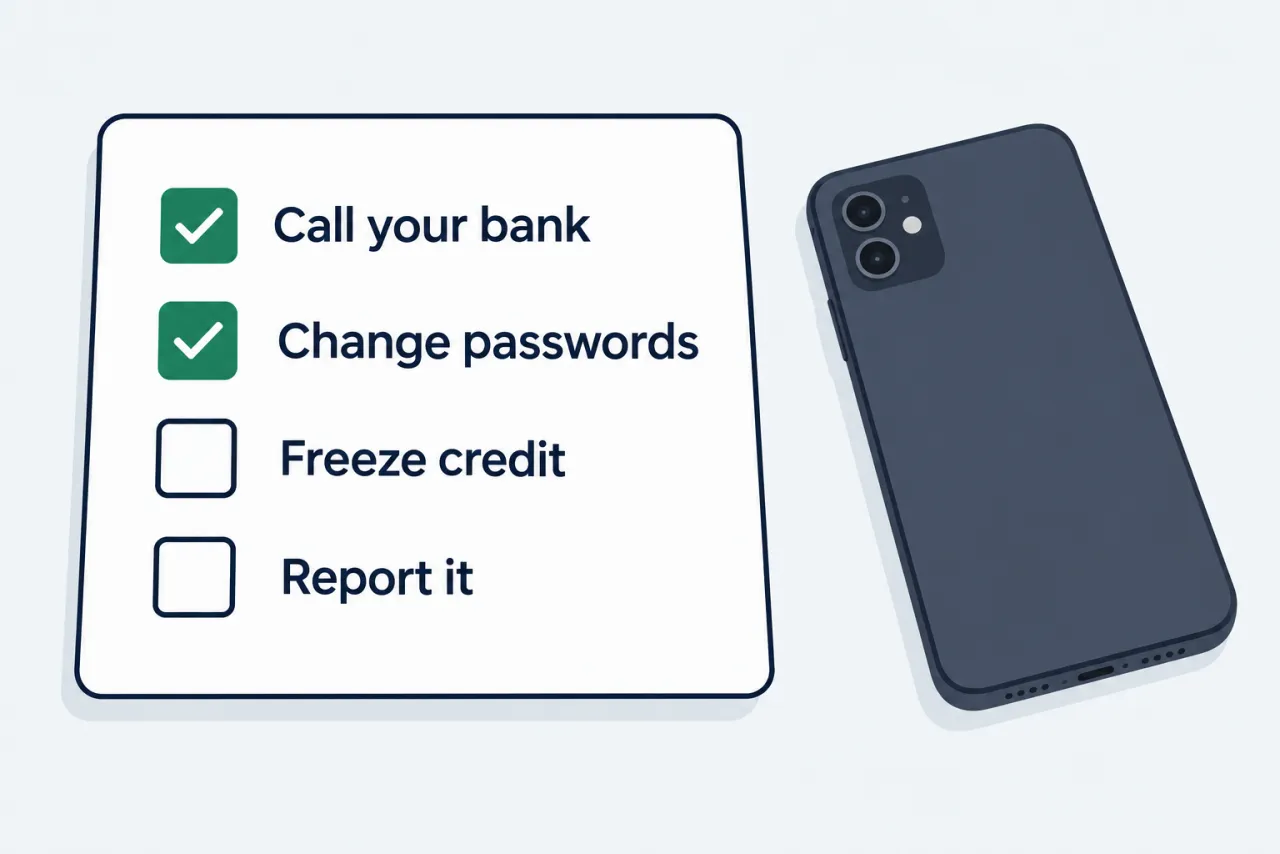
Do the step that matches what you gave, then finish with the report.
Use a phone number or website you look up yourself, such as the one on the back of your card, never a number the caller gave you. Reversal is not guaranteed, but asking fast gives the best chance.
-
Card number or card payment
Call your card issuer, say a scammer has the number, and ask to cancel it and dispute charges.
-
Bank details, a transfer, or a code your bank sent
Tell your bank or app what you shared, even a code, and ask to stop or reverse payments.
-
Gift card, wire, or crypto
Call the card issuer, wire company, or crypto exchange, report the fraud, and keep every receipt.
-
Social Security number or personal details
Go to IdentityTheft.gov for a free recovery plan, place a fraud alert, and check your credit reports.
-
Remote access to your computer
Disconnect it, run a security scan, and change important passwords from a different device.
-
Report the scam
Tell the FTC at ReportFraud.ftc.gov what happened, including the number that called and when.
Report the scam to the FTC →
What this guide covers
This guide helps you
- Show you who to contact first for what you shared
- Point you to the FTC report and identity recovery steps
- Help you spot the follow-up refund call
- Tell you to contact local police if you were threatened
This guide never
- Recover money for you or charge a recovery fee
- Find out who the caller is or where they are
- Ask for your card, bank, or Social Security details
- Promise a payment will be reversed
We help you contain the damage and report it through official channels; we do not chase, unmask, or track the person who called you.
Moves that feel right but lead nowhere
These moves are understandable but rarely help; here is the route that does.
-
Calling the scammer back to demand your money
It hands them another chance to pressure you or take more.
Instead: Call your bank or card issuer on a number you look up yourself.
-
Paying a company that promises to recover your money
The FTC warns recovery offers are often a second scam aimed at past victims.
Instead: Ask your bank, card issuer, or payment company to dispute or reverse it.
-
Looking up the caller's name and address from their number
Scam numbers are often spoofed, and a number does not reveal a private person.
Instead: Give the number, date, and time to the FTC at ReportFraud.ftc.gov.
-
Waiting to see whether anything bad happens
Money movers and credit bureaus can only act on what they have been told.
Instead: Make the first call today, then place a fraud alert if personal details were shared.
-
Trusting a new caller who says they are the FTC or your bank
Caller ID can be faked, and follow-up scams often pose as helpers.
Instead: Hang up and call the organization back on its official number.
Questions people ask
Can I get my money back after paying a scam caller?
Sometimes. It depends on how you paid. The FTC notes federal law protects you from unauthorized credit card charges; for debit cards and payments you approved while being deceived, a dispute depends on your bank or issuer. Banks, payment apps, and gift card issuers can sometimes stop or reverse a payment if you ask quickly. Wire transfers and cryptocurrency are much harder to reverse, but you should still ask. No one can guarantee a refund.
I only gave my name and address. Is that a problem?
On its own it is lower risk, but expect more scam calls, texts, and mail that use those details to sound convincing. Be extra wary of anyone who later calls about a refund or an account problem. If you also shared your Social Security number or account details, follow the identity recovery steps at IdentityTheft.gov.
Should I tell my bank even if no money has left my account yet?
Yes. If you shared a card number, account details or a code, call the number on your card or statement now; the bank can watch or lock the account before anything moves. Then report at ReportFraud.ftc.gov, the FTC form for scams where you shared details. Step-by-step for the complaint forms: How to Report a Spam or Scam Call to the FTC, the FCC and Your Carrier.
The same person keeps calling me back. What should I do?
Do not engage and do not confirm anything. Block the number (how: How to Block a Number on iPhone and Android), and turn on your phone's or carrier's spam filtering. If the caller threatens you or you feel unsafe, contact local police.
Can you find out who the scammer is from their number?
No. Scam callers often fake the number shown, and a phone number does not reveal a private person's name or address. We do not run a lookup database. The useful move is to give the number, date, and time to the FTC and your bank.
Official sources
Rules and phone settings change. Check the current page before you act.
- reportfraud.ftc.gov — reportfraud.ftc.gov