
CallerCheck reference
Site Map: Every CallerCheck Spam-Call Defense Guide
Short answer
Each guide covers one part of dealing with unwanted calls and texts you receive: deciding whether to answer, recognizing a scam, blocking, reporting, or recovering after contact. Pick your situation below, or start at one of the hubs.
Browse all guidesBrowsing the site map needs nothing from you, and we never ask for a phone number.
- Defense only
- Every guide is about calls and texts you received, never about finding people.
- Independent
- Not affiliated with any carrier, phone maker, app, or government agency.
- Reviewed September 2026
- Guides point to official FTC, FCC, Apple, Google and carrier sources.
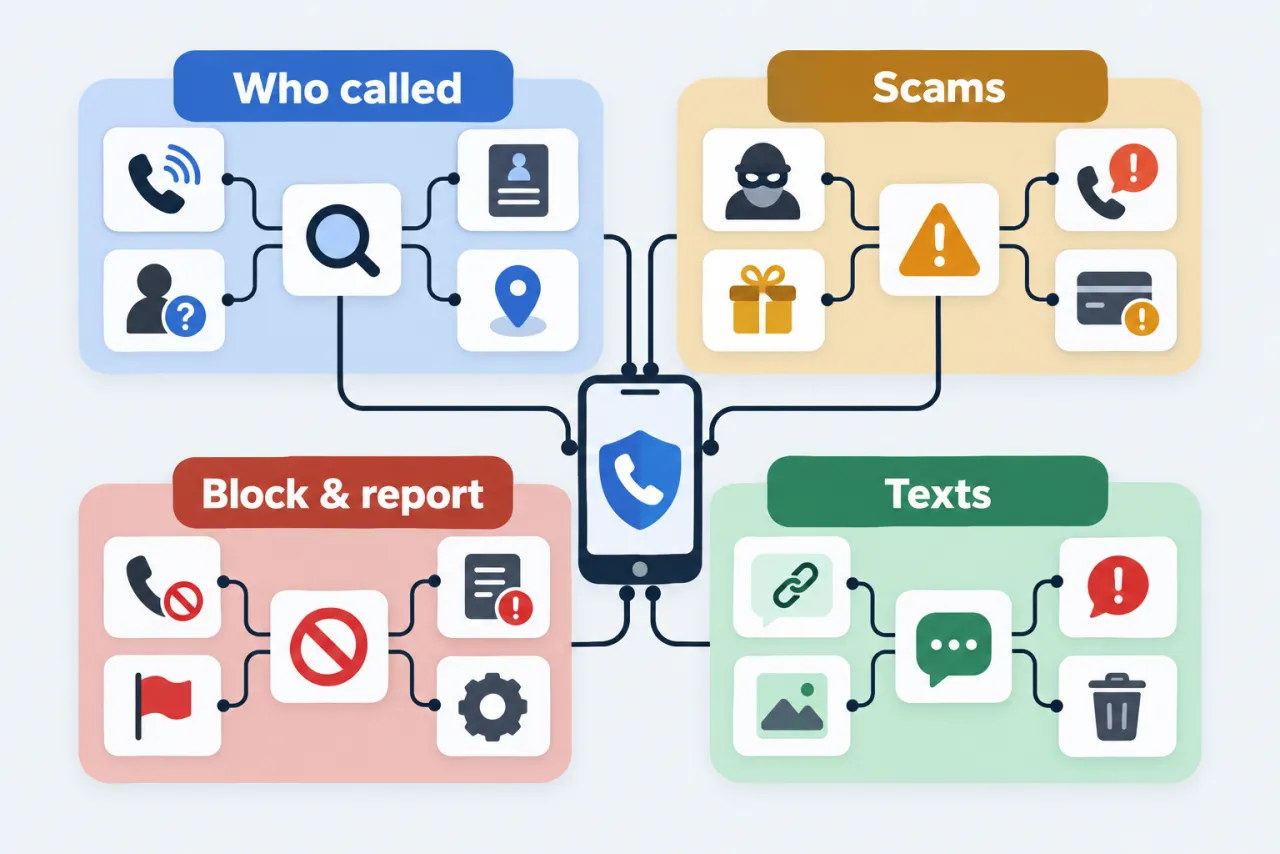
Start at a hub
Four entry points that link out to everything else on the site.
-
Unknown caller
Got a call you don't recognize? Start with the unknown-number guide.
-
Protection checklist
The settings and habits that cut spam and scam calls the most.
-
FAQ and glossary
Short answers and plain definitions for terms like spoofing and smishing.
-
Responsible use
What we help with, what we refuse, and the safe alternative.
Note: Menu names in the how-to guides vary by carrier, phone maker and OS version.
All guides by topic
Every page grouped by topic, with a one-line summary of what it covers.
Who called me — identify an unknown number
-
Deciding what to do about a call
Who called me from this number?
Check whether an unknown caller is likely spam, a scam, or someone worth calling back.
Start with an unknown call → -
Deciding what to do about a call
Is it safe to answer or call back?
The signs of a likely legitimate call versus likely spam, before you pick up.
Decide before answering → -
Deciding what to do about a call
Missed call, no voicemail
Why silence is a signal and when ignoring the call is the safe choice.
Read the missed-call guide → -
Deciding what to do about a call
An unknown international number
One-ring callback scams and why not to return a foreign call you weren't expecting.
Check the international guide →
Types of spam & scam calls
-
Recognizing a scam or how it works
IRS or tax scam calls
How the threat script sounds and how the real tax agency actually contacts you.
Spot a tax scam → -
Recognizing a scam or how it works
Fake bank fraud calls
Why no real bank asks you to move money or read out a code.
Spot a fake bank call → -
Recognizing a scam or how it works
Tech support scam calls
The virus and refund scripts, and why you never grant remote access.
Spot a tech support scam → -
Recognizing a scam or how it works
Robocalls and prerecorded spam
What robocalls are and why pressing a key makes things worse.
Understand robocalls → -
Recognizing a scam or how it works
Common robocall scripts
A field guide to warranty, lower-rate, delivery and prize scripts.
Read the script guide →
Block unwanted calls
-
Blocking, filtering or reporting
-
Blocking, filtering or reporting
Stop spam calls on iPhone
Every built-in iPhone setting that silences, filters or blocks unwanted calls.
Set up iPhone filters → -
Blocking, filtering or reporting
Stop spam calls on Android
The Phone app's spam labels, filtering, and block-and-report options.
Set up Android filters → -
Blocking, filtering or reporting
Carrier spam-blocking services
What carrier labels like Scam Likely mean and what their services cover.
Compare carrier services →
Report & register
-
Blocking, filtering or reporting
Report a spam or scam call
Where to report to the FTC, the FCC and your carrier, and what to note.
Report a call → -
Blocking, filtering or reporting
The Do Not Call Registry
What registering does for legal telemarketing and why scammers ignore it.
Learn about the registry → -
Recovering after contact or misuse
You gave a scam caller your information
Damage control steps if you shared a card, code, payment or personal detail.
Start damage control →
Spoofing & protecting your number
-
Recovering after contact or misuse
Your number is being spoofed
What you can realistically do when strangers call back about calls you never made.
Handle a spoofed number → -
Recognizing a scam or how it works
What caller ID spoofing is
A plain explanation of why caller ID alone never proves who is calling.
Understand spoofing → -
Blocking, filtering or reporting
Protect your phone number
Where numbers leak and the habits that reduce spam and misuse.
Reduce your exposure →
Text / SMS spam
-
Blocking, filtering or reporting
Spam text messages
Identify, block and report smishing without tapping links or replying.
Handle spam texts → -
Deciding what to do about a call
Is this text a scam?
Quick triage for a suspicious text and how to verify it safely.
Check a suspicious text →
Protect & reference
-
Reference and about us
Phone scam protection checklist
The habits and settings that cut spam and scam calls the most.
Open the checklist → -
Reference and about us
Spam and scam call FAQ and glossary
Short answers and plain definitions across identifying, blocking, reporting and spoofing.
Browse the FAQ → -
Reference and about us
-
Reference and about us
Responsible use
What we will and won't help with, and the safe alternative each time.
Read our limits →
Just got a call you don't recognize?. Start from the unknown-number guide; it routes you by what the call looked like. Start with an unknown call
When this doesn’t apply
- You want to find out who owns a number, or a private caller's name or address — A phone number does not reveal a private person's identity or address, and we do not help unmask anyone.
- You want to track or locate the person behind a number — We do not help track or locate anyone; if a caller threatens you, contact your local police.
- You want to monitor another person's calls or texts — Monitoring someone else's phone is outside what we cover; we only help defend your own line.
All guides, by topic
Who called
Scam calls
Block and report
- How to Block a Number on iPhone and Android
- Stop Spam Calls on iPhone Using Built-In Settings
- Stop spam calls on Android with the tools already on your phone
- Carrier Spam-Blocking Services: What They Do and Don't Do
- How to Report a Spam or Scam Call to the FTC, the FCC and Your Carrier
- The Do Not Call Registry: What It Stops, What It Can't, and Why It's Still Worth It
Spoofing, texts and protection
About CallerCheck
More from CallerCheck
Questions people ask
Where should I start if I just got a strange call?
Start with the guide on who called you from an unknown number. It walks through the signs of spam or a scam and points you to the right next step, whether that is ignoring it, blocking it, or reporting it.
Which guides help if my own number is being misused?
If strangers say you called them, start with the spoofed-number guide; to reduce where your number is exposed, use the guide to protecting your phone number.
How often are these guides reviewed?
The guides were last reviewed in September 2026 against official sources such as the FTC, the FCC, Apple, Google and the major US carriers. Phone menus change with OS updates, so the how-to pages describe settings with that caveat.
I already shared information with a scam caller. Which guide do I need?
Go to the guide for when you gave a scam caller your information. It covers what to do first if you shared a card number, a bank detail, a one-time code or a payment.